
Deterministic Freedom
Choice in a predetermined universe

Been thinking about how, in a totally deterministic universe (i.e. everything happening from strict rules, no violations, no randomness), do we experience relative freedom and choice and such?
Here’s basically my best description so far as the result of long back-and-forth with AI.
I still don’t get it full FYI, and I don’t think this is yet a perfect description, but hinting at some keys that are somewhat close, but not perfectly direct like I would like.
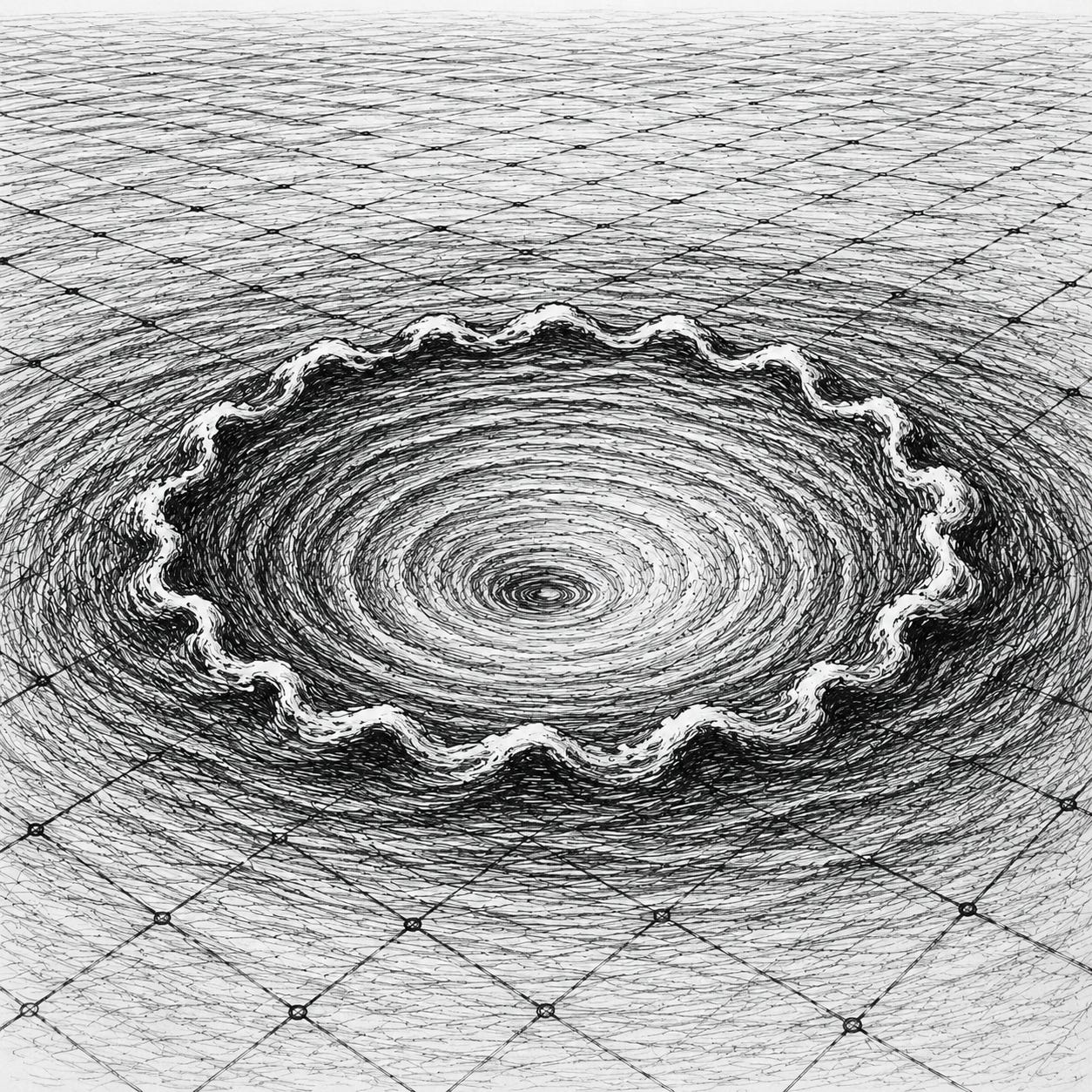
Basically something like, as complexity emerges from the underlying vibe mesh / experiential field, nesting and nesting and nesting into higher more complex structures, the structures evolve information systems, and soon forms of intelligence for weighing options and “making choices”, modeling the world, and acting accordingly. But that is like a womb, a standing wave in an endless grid. It is still perfectly integrated, perfectly determined, but it is unknowable until experienced, and every micro action, while fully determined, might somehow create basically pockets of apparent freedom in the discrete mesh.
But there is no actual freedom, like you’d naively imagine. You can’t just “randomly” decide or do something completely unrelated to the state of your entire being at this point. In that sense it’s all deterministic.
The Core Problem
Assume the strongest version of determinism.
The universe has one exact state at each moment.
That state includes everything:
every particle
every field
every body
every brain
every memory
every desire
every fear
every thought
every hesitation
every feeling of choice
The laws of nature take that complete state and produce exactly one next state.
Reality unfolds as a single chain:
State₀ → State₁ → State₂ → State₃ → State₄
There is no branching at the level of reality.
There is no moment where the same exact universe can go two different ways.
If reality were rewound to the exact same state, the exact same future would occur.
That is the hard determinist picture.
Now the central question:
If the universe is predetermined, why does it feel like an agent can opt in or opt out, go left or right, try or give up, integrate or fragment, choose wisdom or choose pain?
This is the whole mystery.
The answer is: The feeling of choice exists because the agent is an internal modeling system that does not know its own next state before computing it.
The universe may have one future.
But the agent does not experience that future as already known.
The agent experiences the process of computing it.
That process feels like choice.
The Most Important Distinction
There are two completely different concepts that constantly get mixed together.
Reality-level openness
This means: The exact same universe-state could produce Future A or Future B.
Hard determinism says: No.
There is no such openness.
Agent-level openness
This means:
The agent represents Future A and Future B, does not yet know which action it will produce, and must deliberate until one action emerges.
Hard determinism says: Yes.
This happens constantly.
The crucial point is that the agent’s internal branching is deterministic too.
This is where most explanations become fuzzy.
People hear:
The branching is inside the agent.
And unconsciously imagine:
The agent contains A or B and then freely selects one.
But that is not what hard determinism is claiming.
The hard determinist claims something much stronger:
The branching process itself is deterministic.
The possibilities are deterministic.
The weighing is deterministic.
The uncertainty is deterministic.
The feeling of freedom is deterministic.
The final action is deterministic.
Everything is deterministic.
The Chess Engine Example
Imagine a deterministic chess engine.
It receives a board position.
It searches possible moves:
Move A
Move B
Move C
Move D
It evaluates consequences.
It compares scores.
It eventually chooses Move C.
Now ask: Could the engine have chosen Move B?
If the board position, program, hardware, memory, and timing were exactly the same, then no.
It would choose Move C every time.
But did it still evaluate Move B?
Yes.
Did Move B exist inside the search tree?
Yes.
Did the comparison matter?
Yes.
Was there uncertainty inside the process before the answer was computed?
Yes.
Did the engine freely select among metaphysically open futures?
No.
This is the cleanest analogy.
The search tree branches.
The actual computation does not.
The model branches.
Reality does not.
The Human Version
A human deciding whether to quit a job may internally represent:
Stay.
Leave.
Negotiate.
Wait.
Start over.
Do nothing.
These possibilities feel real because they are real as internal representations.
The body may tense.
The imagination may simulate futures.
The emotions may pull in different directions.
The mind may rehearse conversations.
Memory may bring up past failures.
Desire may picture relief.
Fear may picture collapse.
From the inside, this feels like standing before many doors.
But the hard determinist says:
There are not many physically open doors.
There is one physical unfolding in which the brain represents many doors.
The agent does not know which door it will walk through until the deliberation finishes.
But the deliberation itself is already part of the one determined unfolding.
Why It Feels Like Free Opting In or Opting Out
The feeling of free choice comes from several layers happening at once.
First, the agent represents multiple actions.
Second, the agent does not know which action it will perform.
Third, the agent can imagine itself doing each one.
Fourth, the agent can feel internal pressure toward one option and resistance toward another.
Fifth, the agent has a self-model that says: I am the one deciding.
That self-model is useful.
It coordinates action.
It binds memory, body, emotion, and planning into one center of control.
But in hard determinism, that self-model is not an uncaused captain outside the system.
It is another part of the system.
The thought: I could give up, is determined.
The thought: No, I should try, is determined.
The rebellion: I will do the opposite just to prove I can, is determined.
The final action is determined.
The feeling of authorship is determined.
Nothing is outside the chain.
The “I Can Always Do the Opposite” Trap
A person may think:
If determinism says I will choose A, I can choose B instead.
But this does not break determinism.
Because the thought:
I can choose B instead
is itself part of the state of the universe.
If that thought leads to B, then B was the determined outcome.
If that thought collapses and A still happens, then A was the determined outcome.
There is no external self watching the deterministic script and then editing it.
The attempt to defy the script is one of the scenes in the script.
The rebellion is not outside the system.
The rebellion is one of the system’s states.
This is where people often imagine a little captain inside the mind.
The captain sees the options.
The captain selects one.
The hard determinist denies the captain exists.
There is only the process.
Including the rebellion.
Including the urge to do the opposite.
Including the desire to prove freedom.
All of it.
Fatalism vs Determinism
This is the most important practical distinction.
Fatalism says:
The outcome happens no matter what.
Determinism says:
The outcome happens because of what.
Fatalism makes action irrelevant.
Determinism makes action necessary.
If a student passes an exam after studying, fatalism says:
They would have passed anyway.
Determinism says:
They passed because studying occurred.
The studying did not change Future A into Future B.
There was only one actual future.
But that one actual future included studying as a cause of passing.
If the student had not studied, that would be a different causal history.
But under strict determinism, that different causal history was never the one that followed from the exact same universe-state.
So effort matters.
Not because effort escapes determinism.
Effort matters because effort is part of determinism.
The Precise Meaning of “Change”
The word “change” causes confusion.
There are two meanings.
Change as replacing the future
Future A was going to happen.
Then I intervened.
Now Future B happens.
Hard determinism says this never happens.
Change as causing a later state
I practice.
Practice changes my brain.
My changed brain changes my future behavior.
Hard determinism says this happens constantly.
So in strict language:
An agent does not change the predetermined future into another future.
An agent changes things inside the predetermined future.
The agent changes later states because the agent is one of the causes of those later states.
The agent does not stand outside the unfolding and redirect it.
Evolution of Agency
Now walk from simple matter to human choice.
At every stage ask:
Has metaphysical freedom appeared?
The hard determinist answer will always be no.
But agency will still grow.
That is the key.
Matter
A rock falls.
There is no model.
No prediction.
No self.
No choice.
Same state, same outcome.
Freedom: none.
Agency: none.
Feedback
A thermostat turns heat on when the room is cold.
Now there is a loop:
world → sensor → switch → action → world
This is more organized than a falling rock.
But the thermostat cannot do otherwise from the exact same state.
Freedom: none.
Agency: tiny control loop.
Self-Maintenance
A cell maintains its boundary.
It regulates chemistry.
It moves toward nutrients.
It avoids damage.
Now there is something like primitive agency.
The system acts in ways that preserve itself.
But every molecular process is still determined.
Freedom: none.
Agency: self-maintenance.
Prediction
An animal predicts danger.
It internally represents:
run
hide
freeze
fight
This is the birth of internal possibility space.
But the possibilities are inside the model.
The actual future is still one.
Freedom: none.
Agency: prediction.
Deliberation
A human weighs options.
The mind simulates:
What if I stay?
What if I leave?
What if I tell the truth?
What if I lie?
What if I give up?
What if I try harder?
The experience of choice becomes vivid.
But the hard determinist says:
The simulation of many options is itself one deterministic process.
The final action is the output of that process.
Freedom: none in the branch-selection sense.
Agency: deep deliberation.
Rebellion
The agent thinks:
I will do the opposite.
I will choose pain.
I will fight integration.
I will sabotage myself.
I will prove I am free.
This feels like the strongest evidence for freedom.
But hard determinism includes it too.
The impulse to rebel is a state.
The decision to sabotage is a state.
The pleasure in contradiction is a state.
The refusal of alignment is a state.
If the agent chooses fragmentation, that fragmentation was determined.
If the agent chooses integration, that integration was determined.
The fact that either can be imagined does not mean either can occur from the same exact state.
Freedom: still none in the metaphysical sense.
Agency: now includes self-opposition.
Alignment
Alignment means the system’s parts become more coherent.
Body, emotion, memory, reason, values, timing, and action begin to resonate.
Misalignment means the parts conflict.
The agent may feel:
This is right.
This is wrong.
This fits.
This violates me.
This is clear.
This is fragmented.
But even here, hard determinism says:
The move toward alignment is determined if it occurs.
The move away from alignment is determined if it occurs.
The agent does not stand above both and freely pick one.
The agent is the process in which one tendency wins.
Freedom: none as uncaused selection.
Agency: internal coherence or incoherence.
Learning
A bad choice leads to pain.
Pain updates the model.
The next time, the agent behaves differently.
Before:
danger estimate = low
reward estimate = high
action = go
After:
danger estimate = high
reward estimate = uncertain
action = wait
Learning is real.
But learning is not freedom from determinism.
Learning is deterministic state update.
Freedom: none.
Agency: adaptive updating.
Self-Modification
The agent tries to become different.
I want better habits.
I want more courage.
I want less fear.
I want more honesty.
I want deeper alignment.
This looks like self-authorship.
But under hard determinism:
The desire to change is determined.
The practice is determined.
The resistance is determined.
The relapse is determined.
The breakthrough is determined.
The new self is determined.
Freedom: none as ultimate self-creation.
Agency: recursive self-shaping.
The Central Formula
The whole deterministic picture can be compressed into one principle:
Same total state + same laws = same next state.
For an agent:
same body
same brain
same memories
same values
same environment
same attention
same fear
same desire
same laws= same thought
= same choice
= same action
If anything were different, the action might be different.
But if everything is exactly the same, the action is exactly the same.
That is determinism.
Why the Feeling Is So Convincing
The feeling of freedom is not stupid.
It is not fake.
It arises because the agent has limited access to itself.
A person does not see every cause shaping their next thought.
They do not see every neural process.
They do not see every memory activation.
They do not see every bodily signal.
They do not see the final action before the deliberation finishes.
So from inside, the future is hidden.
And this is the deepest sentence in the entire discussion:
Hidden is not the same as open.
A future can be:
100% determined
and simultaneously:
100% unknown to the agent.
The agent experiences:
unknown
as:
maybe A
maybe B
The future is hidden because the agent has not yet computed its own next state.
The agent calls this condition:
choice.
The Cleanest Answer
How can the universe be predetermined, yet an agent feels free to opt in or opt out?
Because the agent is not watching the predetermined future from outside.
The agent is inside the predetermined future, running the computation that produces its next action.
Before the computation finishes, the agent represents several possible outputs.
Because the agent cannot yet see which output it will produce, the outputs feel open.
But from the hard-determinist view, the output is already entailed by the complete state.
The openness is experiential.
The determination is metaphysical.
Both can be true at once.
Final Map
Hard determinism says:
The universe has one actual future.
The same exact state cannot produce two outcomes.
Agents do not freely select among physically open timelines.
Agents represent possible timelines internally.
Those representations are deterministic too.
The weighing of those representations is deterministic too.
The feeling of freedom is deterministic too.
The action is deterministic too.
Trying matters because trying is a cause.
Giving up matters because giving up is a cause.
Learning matters because learning is a cause.
Alignment matters because alignment is a cause.
Rebellion matters because rebellion is a cause.
None of them escape causality.
So the final hard-determinist claim is not:
Deterministic yet free.
It is:
Deterministic and therefore not free in the libertarian sense, while still producing creatures that necessarily experience themselves as if they are free.
The reason they experience that feeling is not because reality branches.
It is because an intelligent system must represent alternatives internally while computing its next action.
The representation of alternatives is deterministic.
The feeling of freedom is deterministic.
The argument about freedom is deterministic.
Even the frustration with the explanation is deterministic.
A hard determinist follows that logic all the way down.
The final picture is therefore:
Not no agency, but no metaphysical openness.
Not no choice, but choice as determined computation.
Not no effort, but effort as one of the causes inside the only future that ever happens.
A deterministic agent does not change the one future into another future.
A deterministic agent is one of the processes by which the one future happens.